

Online Violence Prevention Toolkit Addressing Violent Radicalisation and Harmful Polarisation (Ask Olg-A)
An online and offline (‘Onlife’) action plan to counter violent radicalisation and harmful polarisation
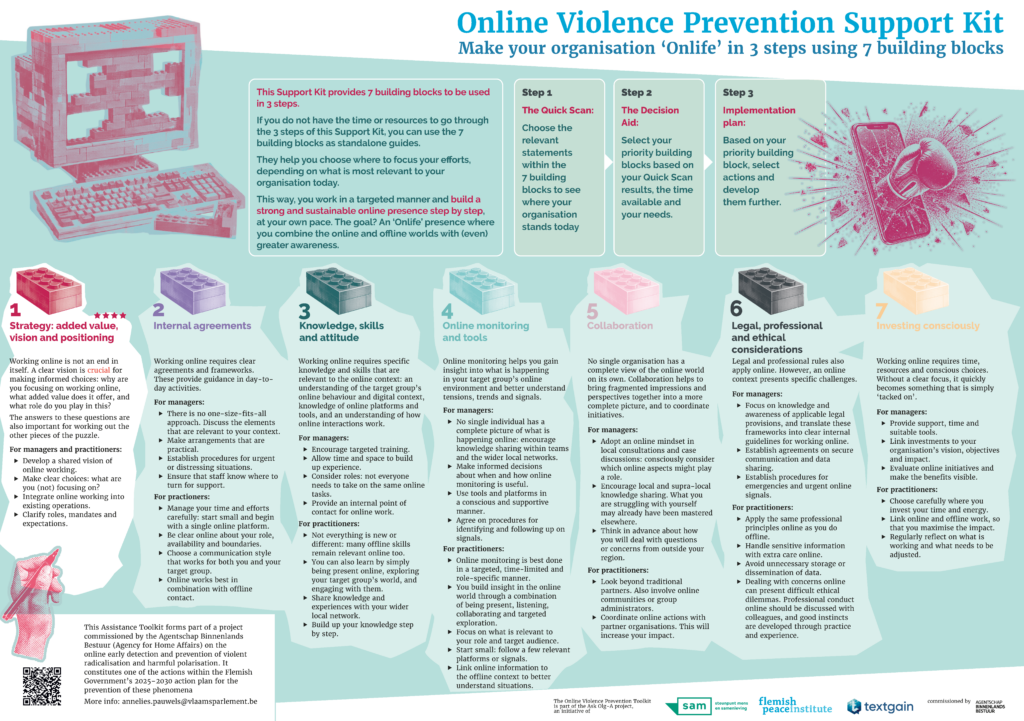
As part of the Ask Olg–A project, the Flemish Peace Institute published a report (in Dutch) by researchers Annelies Pauwels and Louise Macours, a policy advisory paper (in Dutch) and, together with SAM VZW (Centre for Support on People and Society, a non-profit association) and Textgain, two highly practical guides: one for managers (in Dutch) and one for practitioners (in Dutch). This poster (in English) provides a visual summary of the toolkits. The toolkits provide organisations and local authorities with good practices, inspiring examples and a step-by-step plan to strengthen their online work in ways that meet their needs.
The toolkits were presented alongside the research report and policy advisory paper to more than 120 local practitioners, police officers and policymakers on 28 May 2026 at the Vlaams Parlement (Flemish Parliament).
1. What is Ask Olg-A?
Ask Olg-A is a Flemish acronym to describe an Online Violence Prevention Toolkit that Addresses Violent Radicalisation and Harmful Polarisation (in Dutch: Assistentiekit OnLine Geweldpreventie: Aan de slag met gewelddadige radicalisering en schadelijke polarisatie, on- en offline).
It is a project by the Flemish Peace Institute, Steunpunt Mens en Samenleving (SAM) and Textgain, commissioned by the Vlaams Agentschap voor Binnenlands Bestuur (Flemish Agency for Home Affairs). We examine how local authorities and their partner organisations can incorporate online prevention strategies into their existing work to counter violent radicalisation and harmful polarisation, including within the LIVC R (local integrated security cells addressing radicalisation).
The aim is to provide practical guidance for sustainable, integrated policy that makes online prevention as effective as possible.
2. Why is it needed?
Young people, as well as adults, can find themselves in extremist chat groups after just a few likes. Online discussions can quickly descend into toxic exchanges and hate speech. What happens online also tends to have consequences offline.
In these situations, it is important to intervene quickly and effectively. Yet this presents a major challenge for local authorities, professionals, youth workers and street outreach workers. How can you recognise warning signs? How should you respond? Where should you be present online, and where should you avoid becoming involved? How can you add an online dimension to your existing prevention work? And how can you bring all of this together in a sustainable, workable approach?
3. Who is it for?
Ask Olg-A is intended for:
- Local authorities seeking to identify and address signs of problematic radicalisation and polarisation at an early stage.
- Local organisations working with municipalities on prevention, such as welfare organisations, youth work organisations and educational institutions.
- Policymakers at levels above local government who can support local authorities and their partner organisations.
Through this project, we help them create safe and engaged communities, online and offline, where people are alert to emerging concerns.e creëren.
4. How does it work?
The project was organised into four main stages, known as work packages:
- Work package 1: Research report
The Flemish Peace Institute began with a literature review, focus groups and interviews with local authorities and their partner organisations. In a research-based report, we mapped the current situation and identified inspiring examples. - Work package 2: Understanding the online environment
Textgain analysed public discussions on social media. These data help frontline professionals recognise early signs of social unrest, harmful polarisation and radicalisation. Textgain analyses these data using advanced language technology. - Work package 3: Practical guidance
SAM Vzw and the Flemish Peace Institute developed practical toolkits, building on the research findings from work package 1. They co-created two practical guides with relevant practitioners. The toolkits, one for managers and one for practitioners, provide a concrete, step-by-step plan, with tips and tools that can be used directly in online prevention work. - Work package 4: Policy advice and recommendations
Finally, the Flemish Peace Institute developed recommendations to strengthen local authorities’ coordinating role, enabling them to implement effective and sustainable prevention policies that combine online and offline approaches.
This is a two-track approach: providing practical support in the short term while also developing a long-term vision for integrated prevention policy.
5. Who was involved? The Ask Olg-A project partners
Our project brought together several organisations:
- The Flemish Peace Institute: Project lead and coordinator, and lead organisation for the research report.
- SAM: Lead organisation for the development of the practical guidance.
- Textgain: Responsible for analysing the online environment and the data.
We also worked with a broad advisory group and partners such as:
- Vereniging van Vlaamse Steden en Gemeenten (VVSG; Association of Flemish Cities and Municipalities)
- Hogent (HOGENT University of Applied Sciences and Arts) — EQUALITY Research Collective
- Arteveldehogeschool (Artevelde University of Applied Sciences) — Bachelor’s programme in Social Work
- Onlinehulp-Vlaanderen (Online Support Flanders)
- Intergemeentelijke samenwerking Genk-As-Bocholt-Bree-Houthalen-Helchteren-Kinrooi-Oudsbergen-Zutendaal (intermunicipal partnership of Genk, As, Bocholt, Bree, Houthalen-Helchteren, Kinrooi, Oudsbergen and Zutendaal)
- Hogeschool Amsterdam (Amsterdam University of Applied Sciences)
- Mediawijs (Flemish Knowledge Centre for Digital and Media Literacy)
- CAW Limburg (Limburg Centre for General Welfare Work)
This broad collaboration drew on knowledge and experience from a range of sectors to provide local authorities with the best possible support.
Contact researchers Annelies Pauwels and Louise Macours for more information.